
Lithium Batteries and Older Chargers: How to Check Compatibility
Last Updated: November 2, 2026
Quick Summary
An older lead-acid charger is not automatically compatible with a lithium battery. Use the charger supplied with or approved for your specific battery model. Before connecting any other charger, ask the battery manufacturer to confirm the exact charger and settings are compatible. You can go to www.lithosbattery.org to check out products and ask Bill questions!
- Check the specific battery and charger models and their manufacturer-approved charging specifications.
- Confirm the complete charge profile, including voltage, current, termination and any float or equalization settings.
- Ask Bill for help identifying the details, and have the battery manufacturer approve the exact setup before connecting.
- Do not use a charger that applies an incompatible equalization or high-voltage refresh cycle.
Table of Contents
- Can an Older Charger Safely Charge a Lithium Battery?
- Lithium Battery Charger Compatibility Checklist for Older Chargers
- Lithium Battery With Built-In BMS: What Protection It Provides
- Lithium Battery Options to Consider
- Lithium Battery for Golf Cart Upgrades With an Existing Charger
- Decision Tree: Keep, Adjust or Replace Your Charger
- Talk With Lithos Battery About Your Charger
- Frequently Asked Questions
Can an Older Charger Safely Charge a Lithium Battery?
An older charger built for lead-acid batteries is not automatically suitable for lithium. Use the charger supplied with or approved for your specific battery. Do not connect an older charger unless the battery manufacturer confirms the exact charger and settings are compatible.
Many golf cart owners with a 48-volt system assume that matching voltage is enough. It usually isn’t. Lithium iron phosphate (LiFePO4) batteries require a charge profile and termination behavior approved for the specific battery, and many older chargers do not provide them.
Why Lead-Acid Chargers Are Risky With Lithium
Lead-acid chargers can use charging or maintenance stages that are unsuitable for a lithium battery. A battery management system (BMS) provides protections defined by the battery manufacturer, but it is not a substitute for an approved charger and charge profile.
- Float charging: Many lead-acid chargers hold a maintenance voltage indefinitely. Whether any float setting is acceptable depends on the specific battery manufacturer’s instructions.
- Equalization cycles: Some older units run periodic high-voltage equalization. This can exceed lithium limits.
- No cutoff: A charger without automatic shutoff keeps running after the pack is full.
The risk is not just a dead battery. Repeated overvoltage can damage cells and shorten lifespan.
Lithium Battery Charger Compatibility Checklist for Older Chargers
Before buying a lithium battery, check these items on your current charger. If you can’t confirm them from the label or manual, treat the charger as incompatible until the battery manufacturer confirms it.
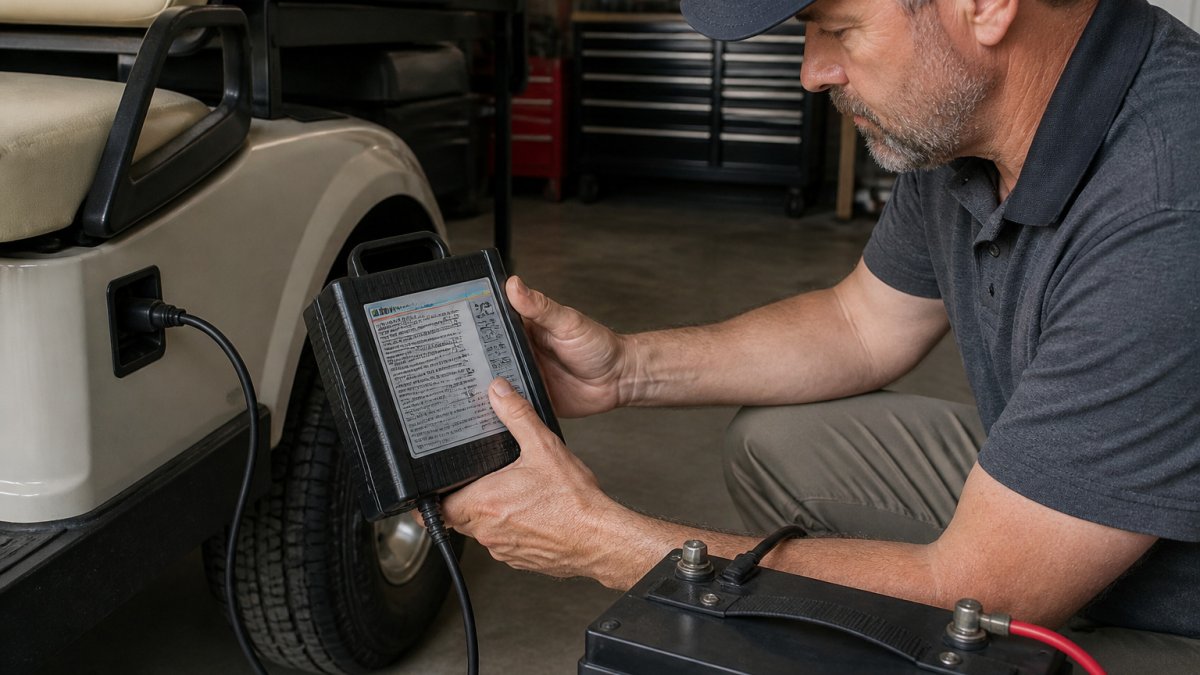
- The charger and its actual charge-voltage settings are approved for the specific battery model; a matching nominal voltage alone is not enough
- The complete LiFePO4 charge profile matches the battery manufacturer’s specifications
- Charge termination behavior approved for the specific battery
Voltage, Charge Profile and Current Limits to Check
Look at the charger’s data plate for output voltage and maximum amperage. Compare the absorption voltage (the voltage held while topping off) with the battery specification. Use these details when asking the battery manufacturer for approval; a match on paper is not approval.
Current matters too. A high-amperage charger can push more current than the battery’s rating, even if the voltage is correct.
The checklist below lists the items to verify on your current charger before buying a lithium battery.
|
Check |
What to confirm |
Why it matters |
|---|---|---|
|
Output voltage |
Meets the specific battery manufacturer’s charging-voltage requirements |
Mismatch can damage the pack |
|
Charge mode |
Lithium or LiFePO4 mode, or selectable profile |
A mode label alone does not establish compatibility |
|
Shutoff |
Charge termination behavior approved for the specific battery |
Charging behavior must follow the battery manufacturer’s instructions |
|
Equalization |
No equalization or high-voltage refresh cycle |
Can exceed lithium voltage limits |
|
Current |
Maximum charge current within the battery rating |
Excess current can damage the battery or trigger protection shutdowns |
|
Identification |
Charger model and manufacturer identifiable |
Needed to confirm settings |
Lithium Battery With Built-In BMS: What Protection It Provides
A battery management system (BMS) provides protections specified by the battery manufacturer. Its functions and limits vary by model. It does not make an incompatible charger safe; use an approved charger and follow the battery instructions.
What the BMS monitors and controls
Depending on the model, a BMS may monitor and respond to conditions such as:
- Cell overvoltage: The BMS may interrupt charging when a cell exceeds its specified limit.
- Cell undervoltage: The BMS may interrupt discharge when a cell falls below its specified limit.
- Overcurrent: The BMS may interrupt operation when current exceeds a specified protection threshold. Do not use this protection as a charging control.
What a BMS cutoff actually does, and does not do
Protection behavior differs by battery and charger. Consult the specific manuals and do not assume a BMS cutoff makes an incompatible charger safe:
- BMS protection is model-specific and does not replace an approved charger. An older lead-acid charger that keeps applying voltage after cutoff is still running its absorption or float stage, and some units will fault, alarm, or restart repeatedly when they see the battery disappear from the circuit.
- Repeated interruptions need a model-specific check. If charging repeatedly stops or restarts, follow the battery manufacturer’s instructions or ask a qualified technician to diagnose the cause. Do not infer charger compatibility from BMS behavior alone.
- A BMS cannot fix a wrong voltage. A BMS is not a guarantee of protection from an incompatible charging voltage. Do not connect a charger with settings outside the battery manufacturer’s specifications.
How the BMS interacts with older chargers
Before connecting, obtain the battery manufacturer’s approval for the exact battery and charger. A qualified technician can help gather the details. If a previously approved setup shows any of the following symptoms, stop charging and seek help:
- Charger never terminates, voltage holds at float indefinitely after the BMS has already cut off.
- Charger restarts repeatedly, the BMS reconnects, the charger sees a low battery, and the cycle repeats.
- Charger faults or alarms, some smart lead-acid chargers interpret the BMS disconnect as an open circuit or bad battery.
These symptoms warrant a qualified diagnosis; they do not by themselves identify the cause. Use the charger supplied or approved for the specific battery and follow its instructions.
Lithium Battery Options to Consider
Here are battery options to consider. An existing charger must be independently approved for the specific battery model before use. Lithos Battery supplies golf cart and RV batteries and can discuss engine-starting requirements, and its team can help identify details to confirm with the manufacturer before you order.
- Lithos Battery lithium packs. Lithos Battery supplies golf cart and RV batteries and can discuss engine-starting requirements. Standard battery delivery is free within the contiguous 48 U.S. states and Washington, DC; destination restrictions apply. Personalized guidance from Bill Corbett is offered by phone or live video. See our delivery details. Best for owners who want help gathering battery and charger details before buying.
- Lithium iron phosphate packs with a built-in BMS. These are the most common choice for golf carts and RVs. Choose a model with per-cell protection and a clear charger specification. Best for owners who want a protected pack and simple setup.
- Drop-in lithium replacements for lead-acid packs. Some lithium packs are sized to fit existing battery trays. ‘Drop-in’ refers to physical fit only; the charger still needs the battery manufacturer’s approval. Best for owners who want minimal modification.
- Lithium starting batteries. Starting duty has different requirements from deep-cycle use. Ask Bill to discuss your engine-starting needs.
- Lithium deep-cycle batteries for RV off-grid use. Designed for repeated discharge and recharge. Best for owners running solar or extended camping setups.
- Lithium packs sold with a matched charger. Using the charger supplied for the battery avoids guessing about compatibility. Check what is included and the current package price.
Before ordering any of these, confirm the charger details against the checklist above and with the battery manufacturer. Pricing depends on quantity, configuration and delivery, so check Lithos Battery’s website for current prices or request a quote.
Lithium Battery for Golf Cart Upgrades With an Existing Charger
Golf cart owners often ask whether they can keep their existing charger. In many cases the answer is no without a change, so plan for it up front. You can compare golf cart lithium battery models and dimensions before deciding.
Lithos Battery offers installation support. You can see the local installation service and pricing for the Fort Pierce area. Optional golf cart installation is $350 per cart within 50 driving miles of the Fort Pierce warehouse, including extra mounting materials and wiring; the battery is sold separately. Beyond 50 driving miles, request a separate quote. See the installation page for details.
Decision Tree: Keep, Adjust or Replace Your Charger
Some owners may need a different charger; the answer depends on the exact battery and charger models. Use this sequence, in order, and stop at the first step that fails. The goal is to separate chargers that are conditionally compatible from chargers that are simply the wrong tool.
Step 1: Identify the charger type
Look at the label and manual to identify the charger type:
- Dumb or transformer-based charger: Constant voltage or simple taper, no microprocessor, often a metal box with an ammeter. Do not use or modify one for a lithium battery unless the battery and charger manufacturers approve the exact setup.
- Smart lead-acid charger: Microprocessor-controlled with modes such as AGM, gel, and flooded, plus a float or maintenance stage. Sometimes has a lithium mode; often does not.
- Lithium-capable smart charger: Explicitly lists a LiFePO4 or lithium profile with a defined absorption voltage and shutoff. A lithium profile still needs the battery manufacturer’s approval for your specific model.
Step 2: Check voltage and charge profile against the battery spec
Pull the battery datasheet and compare these details:
- Nominal voltage match. Confirm the system class and actual charging settings against the battery manufacturer’s requirements. Matching nominal voltage alone does not establish compatibility.
- Absorption voltage. The charge-voltage profile must match the limits and instructions for the exact battery model; do not apply another model’s numbers.
- Float behavior. If the charger holds a float voltage indefinitely, ask the battery manufacturer whether that float behavior is approved. Many LiFePO4 packs are not designed for indefinite float.
Step 3: Check current against the battery rating
Maximum charge current is on the battery datasheet and on the charger’s data plate. A charger rated above the pack’s maximum charge current can overstress the battery or trigger protection shutdowns even when voltage is correct. Charge current must not exceed the battery manufacturer’s approved charge current; do not size the charger to the old lead-acid bank.
Step 4: Decide, keep, adjust, or replace
- Keep only if the battery manufacturer approves that exact charger and its settings for the battery model.
- Adjust settings only when the battery and charger manufacturers approve the exact configuration. Do not modify or rewire a charger to make it fit.
- Replace if the battery manufacturer does not approve the exact charger and settings, or if unsafe or incompatible conditions cannot be corrected under manufacturer instructions.
Charger types that are usually not adaptable
- Equalization-capable chargers that run periodic high-voltage refresh cycles.
- Desulfation chargers designed to break up lead sulfate, the mode is irrelevant to lithium and can exceed cell limits.
- Maintenance or trickle chargers with no shutoff.
When in doubt, do not connect the old charger. A charger supplied with or approved for your specific battery lets the BMS act as backup protection rather than as a repeated emergency cutoff.
Talk With Lithos Battery About Your Charger
If you’re not sure whether your older charger will work, gather your battery and charger model details and contact the battery manufacturer before connecting. Contact Lithos Battery to discuss your setup or request a quote. Have your cart model and charger details ready so the team can help identify what to confirm with the manufacturer.
US Department of Energy guidance on lithium-ion battery safety
Frequently Asked Questions
Can you charge a lithium battery with an older charger?
An older charger is not automatically compatible. Use the charger supplied or approved for your battery model, and ask the manufacturer to confirm the exact charger and settings before connecting. A BMS is not a substitute for a compatible charger. Lithos Battery can help you identify the details to check.
Which lithium batteries work with older chargers?
There is no universal compatibility based on nominal voltage or a built-in BMS. Ask the battery manufacturer to confirm the exact battery and charger models, charge profile, voltage, current, termination and other settings before purchase or connection.
Do LiFePO4 batteries need a special charger?
Use the LiFePO4 charger supplied or approved for the specific battery. A lithium mode label or BMS alone does not confirm compatibility. Before using another charger, obtain the battery manufacturer’s approval for the exact model and all charge settings.
Can an old lead-acid charger damage a lithium battery?
It can. Lead-acid chargers may use float, equalization or other charge stages that are not approved for a lithium battery, which can lead to overcharging, heat or protection shutdowns. A BMS is not a substitute for a compatible charger. Before connecting, have the battery manufacturer confirm the exact charger and settings. Lithos Battery can help you identify the details to check.